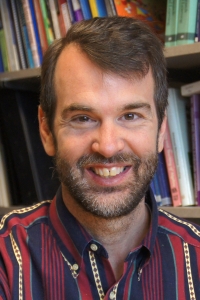
Dr. David Slavit

Boeing Distinguished Professor of Mathematics Education/Mathematics
David Slavit
Phone: (360) 546-9653
Fax: (360) 546-9040
Located in Undergraduate (VUB) 350
Office Hours: By Appointment
Support Staff: Debra Barnett

Greetings. My name is David Slavit, Professor in both the Department of Teaching & Learning and the Department of Mathematics at Washington State University Vancouver. Born and raised in Crystal City, Missouri, I am the son of a glassworker and the youngest of eight children. Fortunately, my career path has supported my desires to travel as well as investigate how we, as humans, think, interact, and learn.

After receiving my B.S.ed. in Mathematics Education and M.A. in Mathematics from the University of Missouri, I began teaching at Lyon College, formerly known as Arkansas College. Upon receiving a sabbatical, I enrolled at the University of Delaware, home of the Fightin' Blue Hens, and obtained my Ph.D in Mathematics Education under Jim Hiebert.

Research

Through numerous federally-funded grants and the initiation of school-university partnerships, I have recently transformed my primary professional focus into analyzing teacher development at the classroom, building, and district levels.  My perspective stems from the belief that teaching involves more than the employment of professional knowledge constructed, formalized, and conveyed by experts (Cochran-Smith & Lytle, 2009).  Sharing Judith Warren Little’s (2003) “optimistic premise of professional community”, my work seeks to go beyond investigations into the acquisition of new knowledge and understand teacher change as a complex process that requires an interactive, communal environment that supports reflection, discourse, and data-based inquiry (Jaworski, 2008; Kazemi & Franke, 2004; McLaughlin & Talbert, 2006). I also have a body of research in the area of student learning, particularly in regard to students' development of algebraic reasoning out of arithmetic thought processes. I have also investigated the effects of technology on teaching and learning at the secondary and postsecondary levels, with a particular emphasis on graphing calculators and web-based activities.

Recent Publications

SELECTED PUBLICATIONS
Nelson, Tamara Holmlund, Slavit, David, & Deuel, Angie (in press). Two Dimensions of an Inquiry Stance: A Theoretical Model for Understanding and Supporting Teachers’ Collaborative Work. Teachers College Press.
Slavit, David, Kennedy, Anne, Lean, Zach, Nelson, Tamara Holmlund, & Deuel, Angie (in press). Support for professional collaboration in middle school mathematics: A complex web. Teacher Education Quarterly.
Slavit, David & McDuffie, Amy Roth (in press). Self-directed teacher learning in collaborative contexts. School Science and Mathematics.
Kennedy, Anne, Deuel, Angie, Nelson, Tamara Holmlund, & Slavit, David (2011). Distributed leadership in professional learning communities. Phi Delta Kappan, 92(8), 20-24.
Slavit, David, Nelson, Tamara Holmlund, & Kennedy, Anne (2010). Laser focus on content strengthens teacher teams. Journal of Staff Development, 31(5), 18-22.
Slavit, David & Nelson, Tamara Holmlund (2010). Collaborative teacher inquiry as a tool for building theory on the development and use of rich mathematical tasks. Journal of Mathematics Teacher Education, 13(3), 201-221.
Deuel, Angie, Nelson, Tamara, Slavit, David, & Kennedy, Anne (2009). Looking at student work. Educational Leadership, 67(3), 69-72.
Slavit, David, Nelson, Tamara Holmlund, & Kennedy, Anne (Eds.) (2009). Perspectives on Supported Collaborative Teacher Inquiry. New York: Taylor & Francis.
Bornemann, Greta, Haury, Scott, & Slavit, David (2009). Collaborative teacher inquiry using “rich” mathematics tasks. Mathematics Teacher, 101(8).
Nelson, Tamara, Slavit, David, Perkins, Martha, & Hathorn, Tom (2008). A culture of collaborative inquiry: Learning to develop and support professional learning communities. Teachers College Record, 110(6), 1269-1303.
Slavit, David & Nelson, Tamara (2008). Supported teacher collaborative inquiry. Teacher Education Quarterly, 35(1), 99-116.
Slavit, David, Nelson, Tamara, Kennedy, Anne, & Laurence, Wendi (2007). The power of teachers working with teachers. Curriculum in Context, 34(1), 6-9.
Slavit, David & Ernst-Slavit, Gisela (in press). Educational reform, mathematics, and English language learners: Meeting the needs of all students. Multicultural Education. To appear in 2007.
Nelson, Tamara & Slavit, David (2007). Collaborative inquiry amongst science and mathematics teachers in the U.S.A.: Professional learning experiences through cross-grade, cross-discipline dialogue. Journal of Inservice Education, 33(1), 23-39.
Slavit, David (2006). Uncovering algebra: Sense making and property noticing. The Mathematics Educator, 16(2), 4-13.
Slavit, David & Nelson, Tamara (2006). Dialogic teacher change: Two cases of supported collaborative inquiry. Working Papers on Culture, Education and Human Development, 2(2). http://www.uam.es/otros/ptcedh/
Sjoberg, Craig, Slavit, David, & Coon, Terry (2004). Writing Prompts and Modeling that Support Mathematical Development and Connections. Mathematics Teaching in the Middle School, 9(9), 490-493.

SELECTED GRANT DEVELOPMENT
Kennedy, Anne & David Slavit. GPS (Guidance Plus Support) System for Improving Mathematics Instruction. Washington State Higher Education Coordinating Board. July, 2007 – August, 2008 ($177,919, funded).
Nelson, Tamara, David Slavit, & Anne Kennedy. A study of professional learning communities amongst secondary science and mathematics teachers: Changes, support systems, and student learning (more commonly known as STRIDE). National Science Foundation Teacher Professional Continuum Award, Grant No. ESI-0554579. March, 2006 – June, 2010 ($1,918,277 funded).
Slavit, David, & Tamara Nelson. Partnership for Reform in Secondary Science and Mathematics (PRISSM). U.S Department of Education Title IIB, Mathematics Science Partnership Program. June, 2004 - September, 2007 ($1,400,000 funded).
Slavit, David & Tamara Nelson. Improving Instruction Through Exemplars in Math and Science (IITEMS). Washington Office of the Superintendent of Public Instruction. February, 2003 – August, 2003. ($90,739, funded).
Kennedy, Anne, Brian Tissot, & David Slavit. Planning for Reform in Secondary Science and Mathematics (PRISSM). National Science Foundation. January, 2000 – July, 2002 ($50,215, funded).
Slavit, David, & Richard Sawyer. Project TEMPLATE: Technology Education Matters: Plan for Learning And Teaching with Educational technology. Preparing Tomorrow's Teachers to Use Technology Grants, U.S. Department of Education. August, 1999 – August, 2000 ($175,000, funded).
Cooper, Kevin, Tom LoFaro, Ray Huffaker, Ron Poshusta, and David Slavit. IDEA: Internet Differential Equations Activities, National Science Foundation. April, 1998 - March, 2000 ($119,141, funded).

CONSULTANCIES
University of Madrid Autonoma, Research and instructional collaboration, David Poveda primary contact. Duties included research symposia and collaboration, instruction of educational psychology seminar, and other consulting duties. Spring, 2006.
Northwest Regional Educational Laboratories, Executive Research Editor, “Improving Adolescent Mathematics”, Julie Peck, author. January, 2005 – October, 2005.
Nishinomiya School District. Invited speaker. Motoke Yanase, primary contact. Two week-long visits to Nishinomiya School District with WSU contingent, research symposia, classroom observation, dialogue with school personnel. Fall, 1997 & 1999.
Hyogo University, Research and instructional collaboration, Shinya Sakitani primary contact. Duties included various research symposia and collaboration, instructional support in mathematics education undergraduate and graduate courses, and support for use of computers in mathematics content courses. Spring, 2001.